Fibery in 2025. Finally a Good Year in Review
TLDR: +85% MRR growth 📈. -85% sales and marketing expenses 📉. 13,500 new leads 🎁. 420 new features and 1400 fixed bugs 💪. Engineering Bottlenecks . Offline retreats in Rzucewo and Larnaca 🇵🇱🇨🇾. fibery.com 🤪. Product unification and polishing 🍱. Dopamine and cortisol 😍😨.
For context
Fibery is an operating system for orgs run by nerds. In Fibery, you can build your own workspace from connected databases, docs, whiteboards, and automations. Instead of adapting your workflow to rigid software, you design the system that fits how you actually work — and everything stays connected.
The Year Things Actually Worked 🎉
2024 was a very hard year. We experienced a spectacular pivot failure, but managed to set a new course and started changing things for the better… sloooowly. 2025 was maybe our first really good year, and we should finally celebrate! The fun part is that we achieved an 85% YoY MRR increase while cutting sales and marketing expenses by 85%. What a coincidence!
Fibery is close to profitability, and with our remaining runway we’re alive by default now. So we spent $10K and purchased fibery.com as a gift to ourselves.
This post will be less interesting, since posts about failures are more entertaining to read. Anyway, I will do my best. Grab some 🍿, pour some ☕, and enjoy numbers, opinions, failures, wins, and future plans!
Let’s start with some numbers:
                          2024         2025
                            --           --
Team size                   30   →       30
MRR growth, YoY             40%  →       85%
Total leads              8,700   →   13,500
Monthly leads              725   →     1125
Leads conversion rate       ~2%  →       ~4%
Releases                    51   →       51
Done features              450   →      420
Past 🦐
85% MRR growth
Every year we wanted to double our MRR, but it was always around +40% YoY. In 2025 we also wanted to double our MRR, and we almost did it. Was it expected? Not at all, especially considering our minimal marketing expenses, no ads, no SEO, etc. Check the total Marketing & Sales expenses by year compared to MRR growth rate:
                               2023         2024         2025
                                 --           --           --
Marketing & Sales expenses     $650K    →   $360K   →    $195K
MRR growth, YoY                  40%    →     40%   →      85%
The monthly Marketing & Sales expenses chart is also quite telling. What happened in July 2024? We reorganised the company, transformed marketing into a growth team, cut marketing expenses, and returned to our Company OS vision.
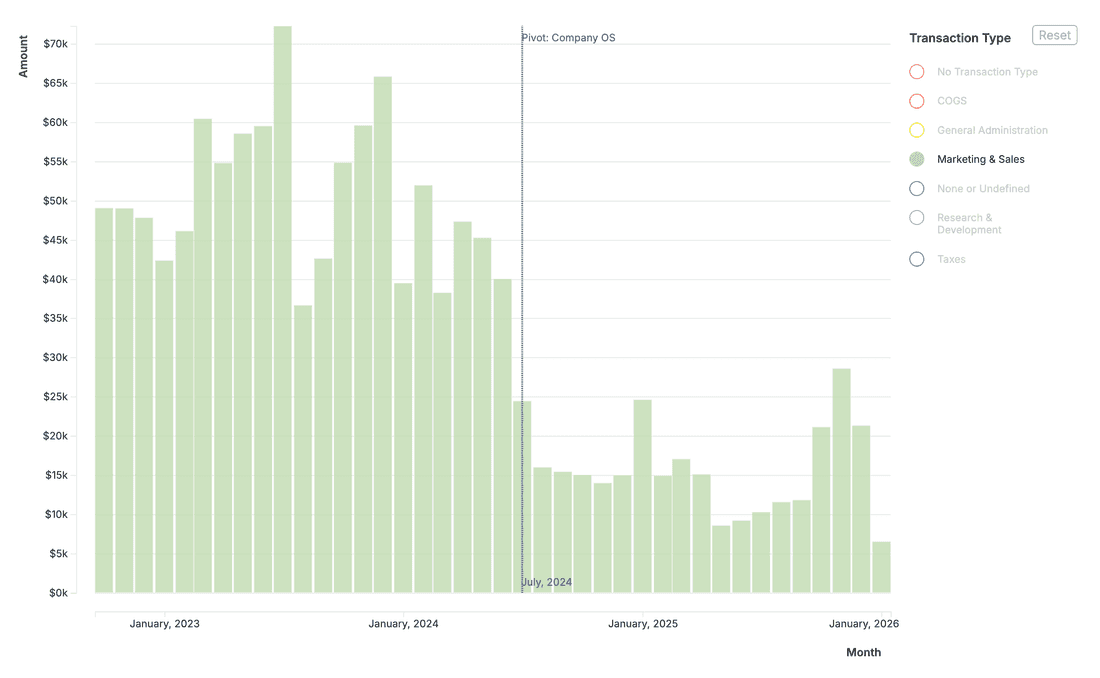
What does this tell us? Get your basics right before investing heavily in marketing. What do we mean by basics? Positioning, pricing, onboarding.
Main sources of MRR growth in 2025:
- 2x better leads-to-customers conversion.
- Price increase in 2024 (note that this was a one-time event, not repeatable).
- Better sales negotiations, fewer discounts.
- Two quite large new accounts landed, one of which should affect MRR significantly in 2026
- Good customer retention.
- Fibery as a product is (finally) quite good.
- 55% more leads.
Let’s talk about leads (a lead is a new registered account in Fibery).
We have barely produced anything with decent chances of attracting leads. Ironically, we got significantly more leads compared to the previous misleadingly active period. Our best months hit 1,400 leads, now it’s around 1,000, still way better than 2024, when we had a month with just 550. That’s thanks to the fundamentals: relatable positioning and happy customers.
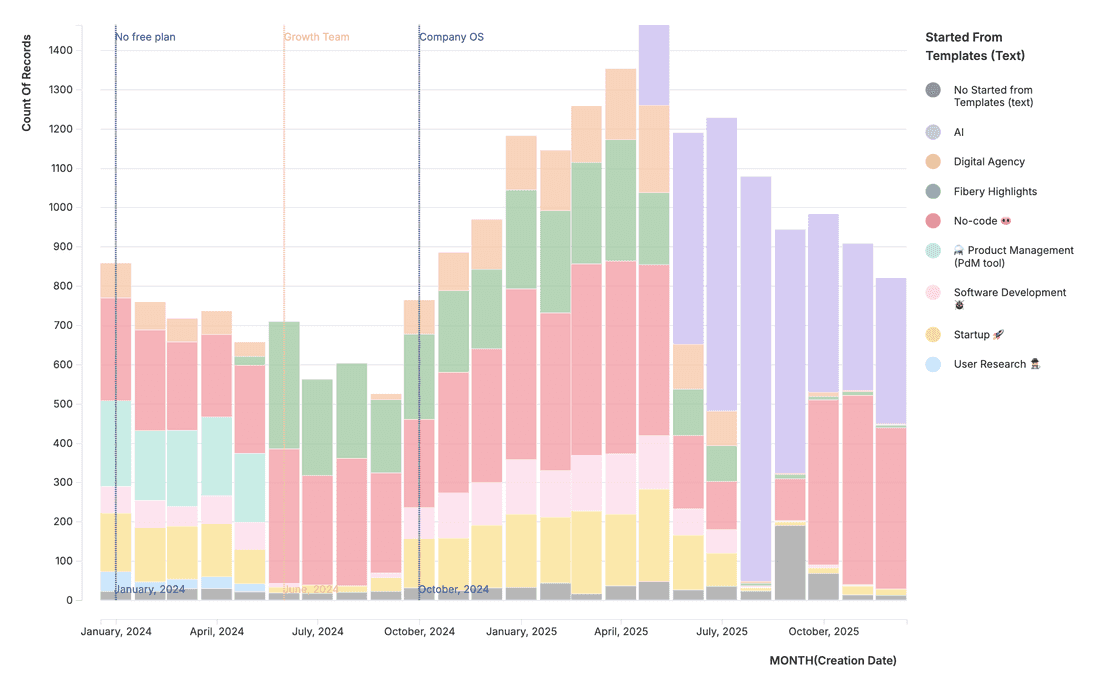
Leads started declining in June 2025, maybe because we switched to AI-generated onboarding, but it’s unclear. Traffic to the website remains quite stable, so it’s more about the Visitors → Leads conversion rate.
We spent nothing on ads, SEO, or conferences, and still grew. But we also didn’t invest in our partners program, didn’t produce much content, and didn’t ship any crazy ideas. Imagine what happens when we actually try.
Sales negotiations 🙂↔️
We’ve stopped giving out unreasonable permanent discounts. We learned to hold our ground when dealing with Enterprise customers. We stopped being shy about charging for paid consulting. All of this boosted MRR.
At the early stage, it’s very tempting (and maybe OK) to give a huge discount to land a significant deal. However, this somewhat undermines the product’s value and isn’t viable long-term. For example, one of our very early enterprise deals was priced at $6 per user per month (they’re still a large and beloved customer, BTW!). Now enterprise costs $40 per user per month and discounts are very rare.
Failed referral program
We launched a referral program in early spring and shut it down in September 2025. The idea was simple: let existing users invite others and get rewarded with Fibery credits. After six months, fewer than 100 users had invited anyone, and no significant customers came from referred sign-ups.
As a result, we decided to close this program and think again. Maybe a traditional affiliate program would be better, since money gives people more incentive to share Fibery? However, we’d risk seeing Fibery links in weird places, but should we be afraid of that? So far we haven’t made any decision.
Top Content we produced
2025 wasn’t a great year for content. I hope 2026 will be better (at least it’s part of our strategy now!)
Best Fibery product content:
- Fibery vs. Notion
- In May 2025 we launched Architects Weekly newsletter*.* It includes updates, tips, and curated resources for people which we call Architects (they build solutions in Fibery). Now it has ~200 subscribers and we’ve gotten quite a lot of positive feedback. BTW, you can still subscribe 😉.
Thought leadership content:
-
In 2026 we’re going to launch a newsletter where we’ll share our ideas, thoughts, observations, and other things. Whatever we figure out, we share. Expect no more than 1-2 pieces per month. Subscribe now to not miss the first edition 😉😉!
Engineering Bottlenecks
For context
Fibery has 30 people on board. The engineering team includes 2 designers, 16 developers, 2 QA engineers, and 1 product manager (who is also the CEO…). Check our development process if you are curious.
🧩 Product management is becoming a problem. We used to have three people in this role. One left, another moved to growth, and now I’m product owner for most features. As a result, I make more mistakes since I can’t dig as deep as needed in some cases.
Here’s an example. We wanted to make pinned filters more useful by letting people change values in them, like quickly filtering tasks by any project, etc. I spent a lot of time thinking about solutions, did several iterations with a designer, and then a developer spent almost two months implementing it. When it was almost ready, we ran internal tests. One savvy person suggested a 4x simpler solution, 3x faster to build… I resisted initially, but rationality won and we started from scratch. Main reason for the failure: my multitasking.
Delegation works to some degree, but the problem remains.
🧩🧩 Another bottleneck is Fibery core. Fibery Core Master (he has a beard, BTW) has fenced the core off from other developers and keeps his garden clean, tidy, and serene 🧘. But many features demand core changes, including permissions. So we have to postpone some features and wait for Fibery Core Master’s availability. He works very hard, but his power is not endless…
All delegation attempts have failed so far, since parties couldn’t agree on the garden plan and cleaning procedures.
While all these bottlenecks aren’t fatal, they increase our error rate, put heavy strain on some people, and impede Fibery’s development.
Offline retreats in Rzucewo and Larnaca
In 2024 we didn’t have any retreat, but in 2025 we fixed that and had two!

In the first retreat, 60% of the team spent a few days in Rzucerwo 🇵🇱. In the second, 75% of the team spent a few days at Larnaca 🇨🇾. Our first retreat in 2023 was very work-focused, and I didn’t like it much. In Larnaca we tried to make it way more relaxing and only spent morning hours on fairly unstructured discussions.

The hang-out-together-and-have-fun part was great, but lack of structure didn’t help with the discuss-something-important-together part. While we did have several deep and cool conversations, it still felt like not enough. Well, maybe it’s never enough for a remote team…
After both extremes, we’ll nail the best formula next time. I think it should be this:
- Dedicate at least 3 full days to the event.
- Plan all important working sessions upfront.
- Spend no more than 4 hours every day on working sessions in the first part of the day.
- …
- PROFIT!!!
Great product development progress and weekly releases
There were 52 weeks in 2025, and we shipped 51 releases. We’ve hit peak performance and we’re riding it. The total value we delivered in 2025 is fantastic.
                 2021      2022      2023      2024      2025
                   --        --        --        --        --
🦋 Releases        34   →    40  →     45  →     51  →      51
💚 Done Features  100   →   200  →    300  →    450  →     420
🦐 Fixed Bugs     900   →  1200  →   1300  →   1400  →    1400
The chart below shows the total highlights score (value of customers feedback) delivered every month:
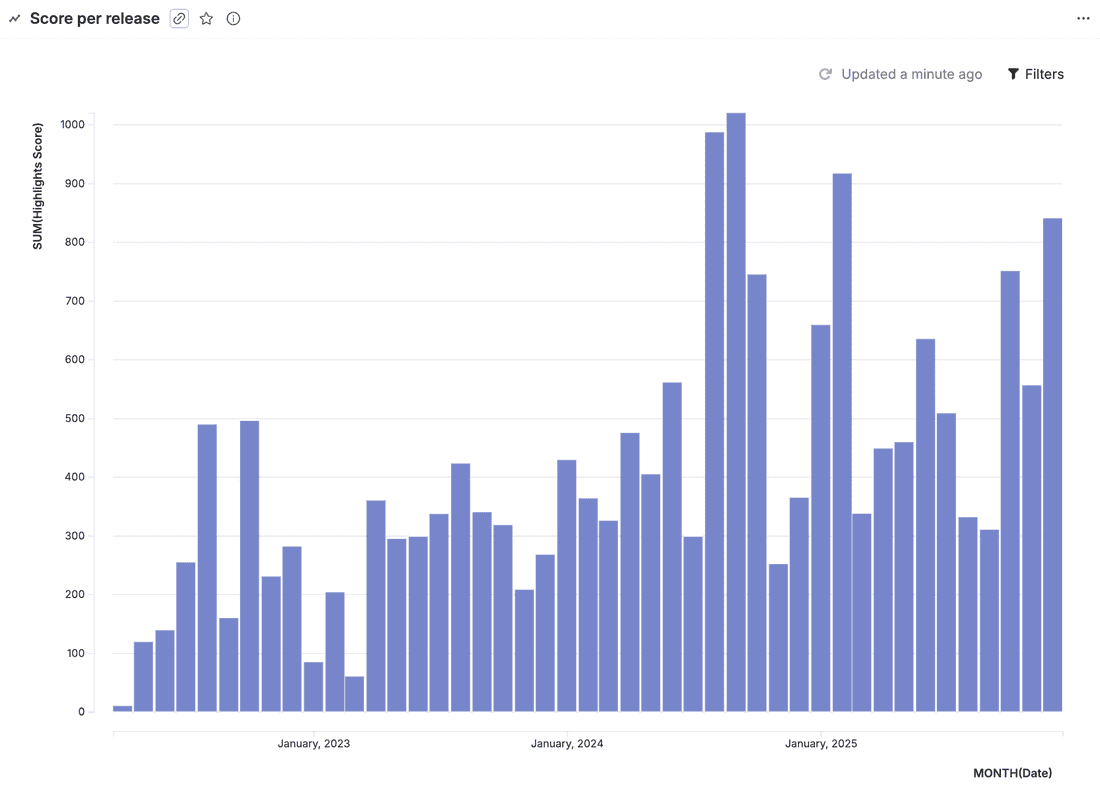
We’ve released 420 features in total, some notable mentions: Dependencies on Timeline View, Required fields, MCP Server, Fibery AI Agent, New Sidebar, tons of Whiteboard improvements, Batch edit. Looking back, it’s insane how much we built in one year… I still can’t believe it 🤯.
Here are several key improvements we made in 2025.
Sharing & permissions
You can share pretty much anything with anyone in Fibery now. You can also 🦚 customize access like in no other tool (that we know of) and 🤖 grant it automatically to assigned users and groups:
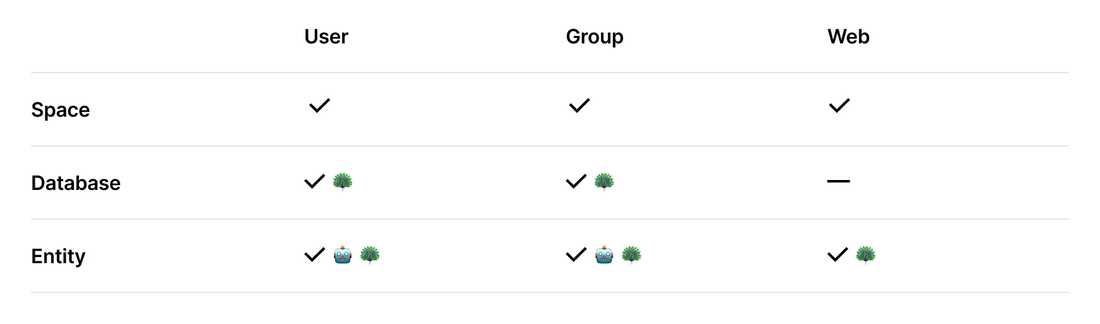
Well, it’s not just “you can” — we know for a fact that you do:
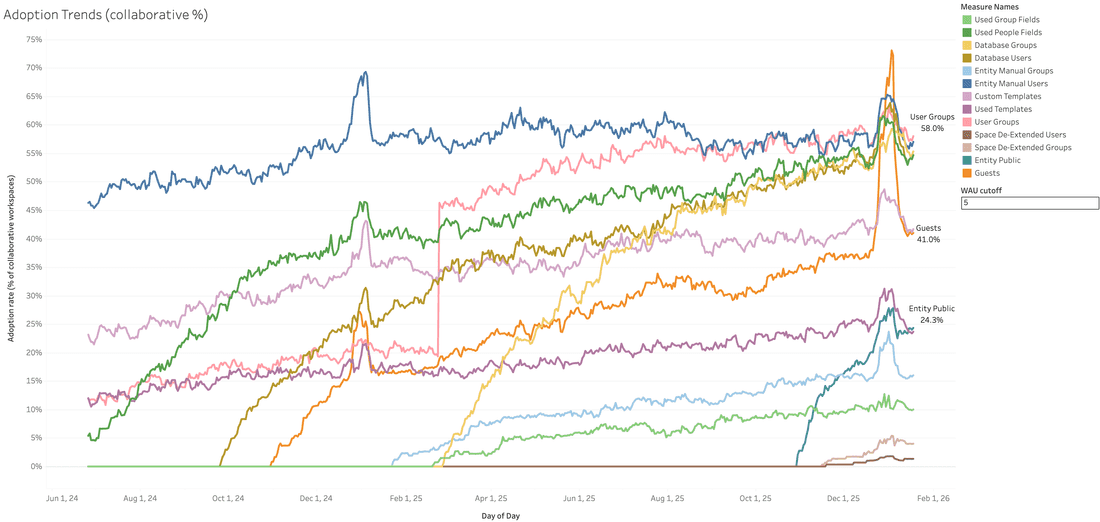
Permissions shouldn’t get in the way of adopting Fibery as a company operating system. We are almost there, but there’s still some work to do in 2026: manage access to users, hide data from admins, and allow to easily create child entities.
Hopefully, we will finish the new access model next year. It would be the single largest (and longest!) project we’ve ever undertaken at Fibery — a story worth a separate book blog post.
New Views: Dashboard, Gantt, Gallery
This year we introduced three new Views: Dashboard, Gantt, and Gallery. All of them are quite popular already. Fibery now has all the major views you can imagine.

Mobile
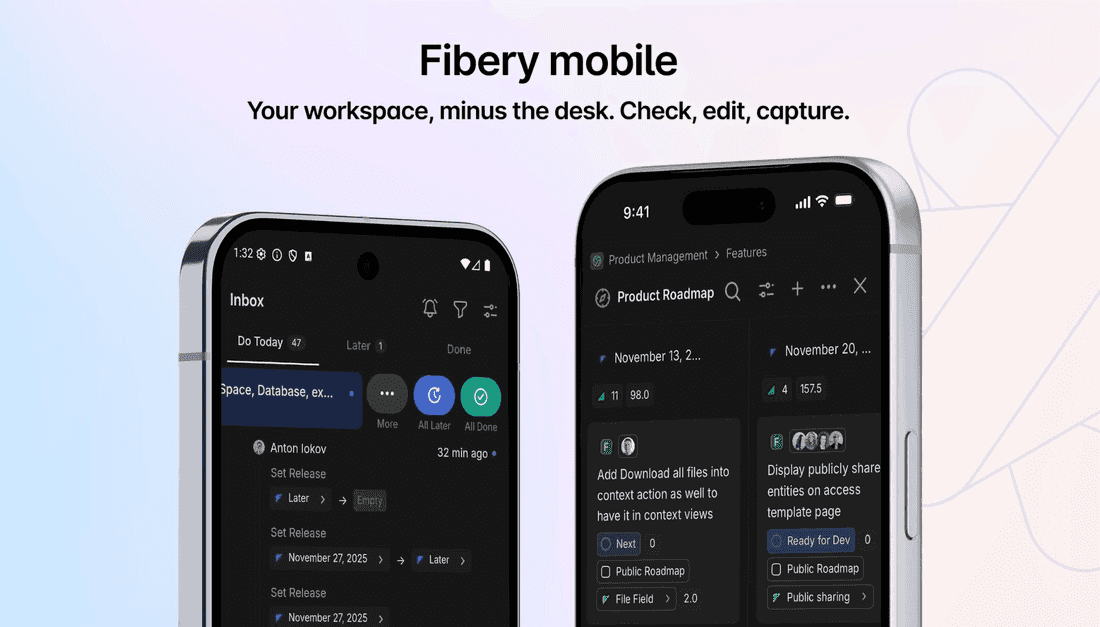
We got the first request to make mobile apps in 2020. We shipped them six years later for iOS and Android. We call this approach “mobile-last”, and we don’t regret anything here. We had to nail more important things first, and only now did we find the resources and opportunity to do it. This first release is already quite good and helpful, and we’re going to improve mobile apps in 2026.
Product unification and polishing
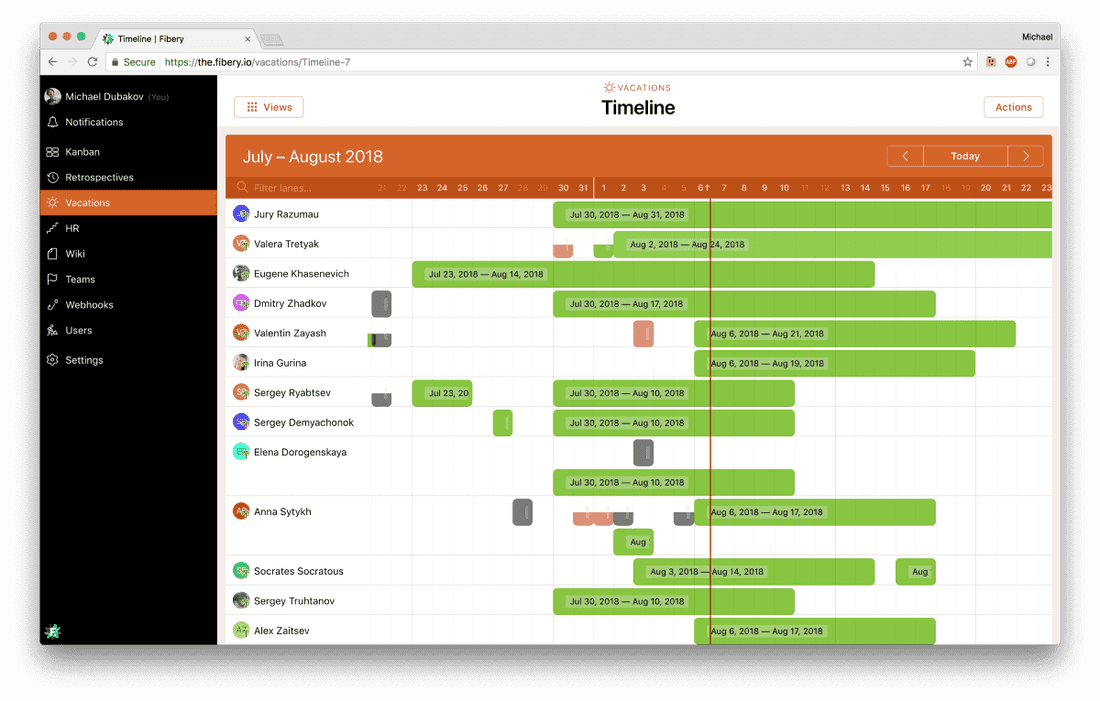
Looking back, it’s insane how much Fibery has changed during the last six years. A single UI screenshot won’t show the difference, but it shows the vibes.
↓
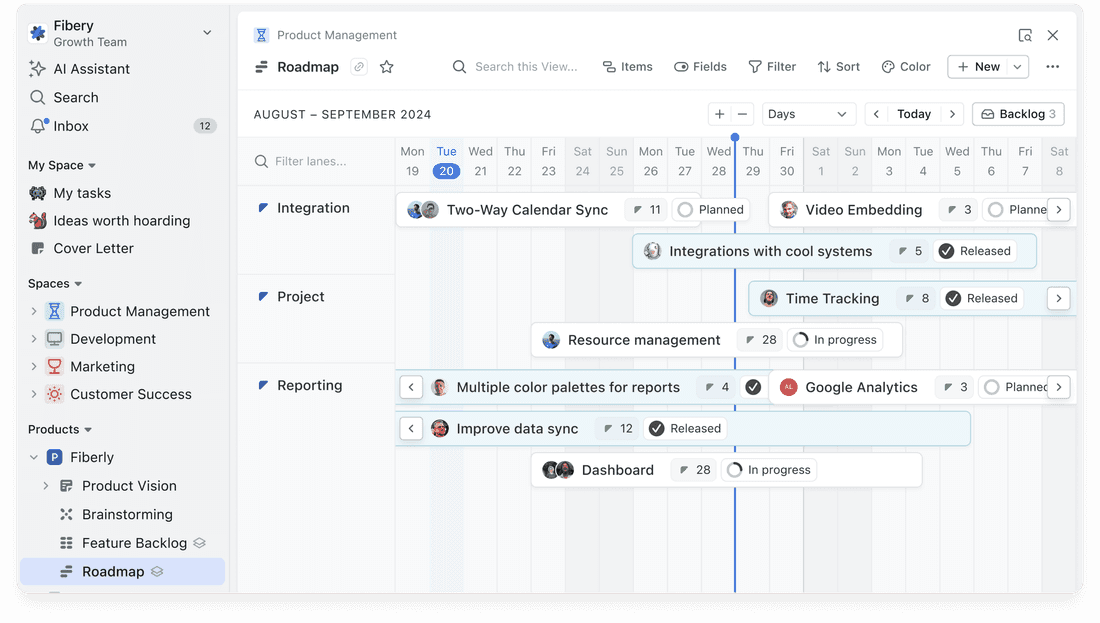
For years we prioritized power. More features and deeper features was always Fibery’s motto. In 2025 we stopped and made hundreds of evolutionary improvements here and there. Fibery got slicker, more visually appealing, and many small usability problems were solved.
It’s always hard for me to prioritize polish over big transformative features. However, without them, a product always feels “not done yet”. I hope we’re getting better at this delicate balance.
Future 🦋
At the end of 2025 we spent many weeks thinking about our future. The result is our Fibery Strategy for 2026 and beyond document. It’s deep and detailed, so if you really want to learn about Fibery’s future, go read it 💥.
Our main takeaway: we want to do things our way, not follow generic best practices, since they aren’t best for us. We’re transparent: we share our mistakes, struggles, and results publicly. We’re honest about weaknesses and only promise what we can deliver. We don’t hide from complexity; we think deeply and independently. We stay playful, approaching hard problems with a smile in the mind. And we’re gritty as hell. We have the strength and determination to survive through some tough shit (near company closure in 2020, emigration, war) and execute over looong horizons (7 years till first signs of success, 3 years to build permissions, …)
We won’t appeal to every person on the planet. We won’t play by the book. We won’t be an average company with a faceless website and a dull brand. We’ll attract like-minded folks who share our values and spread the word.
We also learned that we can’t create simple products. We tried to hide this for years, but no more. We don’t like building simple products. We love complexity, abstractions, and deep solutions (we’d never build Basecamp, or Instagram, or even Linear).
However, Fibery can be complex and powerful for architects while remaining simple for ordinary users.
It can scarcely be denied that the supreme goal of all theory is to make the irreducible basic elements as simple and as few as possible without having to surrender the adequate representation of a single datum of experience — Albert Einstein
Our brand and product is for people who need power, embrace complexity, understand abstractions, and share our culture.
- 🤪 We can’t create simple products →
- 🤓 A nerd is our target persona →
- 😎 Fibery is an operating system for orgs run by nerds →
- 😅 Our goal is to make Fibery powerful for architects, but simple for ordinary users.
And this is what we’re going to do in 2026.
Main growth themes for 2026
New visual identity and stronger brand
Now that we understand who we are and who we serve, we’ll make it obvious from a mile away. You won’t confuse our website, social media post, or screenshot for ClickUp or Monday.
We find inspiration in other nerdy digital products (Posthog, Obsidian, n8n) as well tycoon games, retro camera manuals, and whatnot:
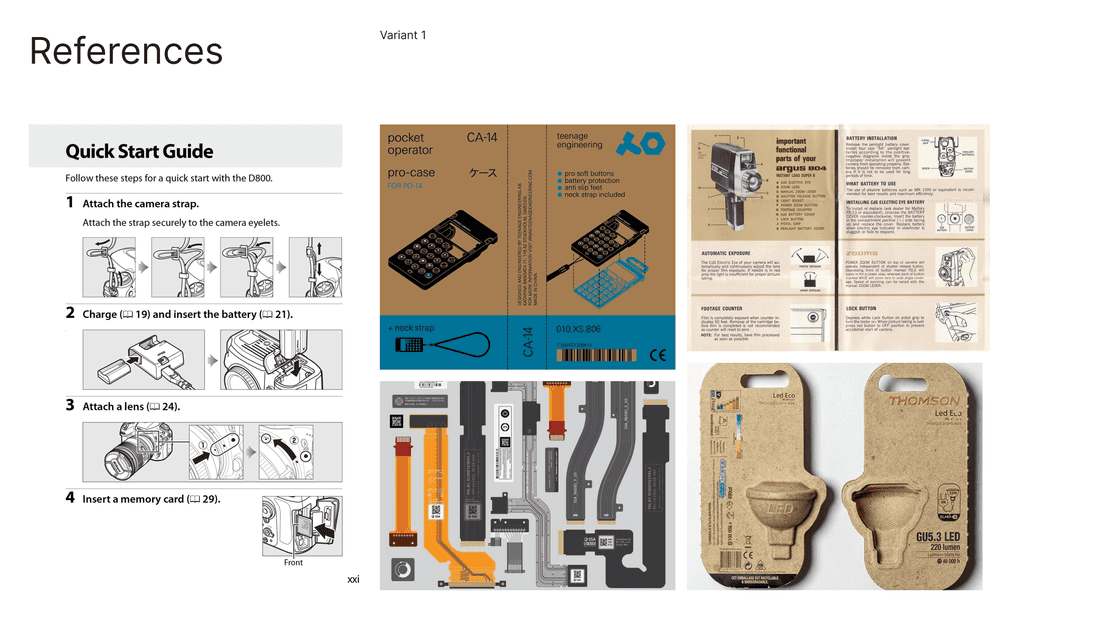
We’ll start by updating our (dot com 🤟) homepage in the coming weeks. Gradually, the new style (and brand in general) will find its way into everything we publish.
Content for humans by humans
In the age of AI slop, we’ll produce human, authentic, and valuable content across four pillars:
- How (and why) to use Fibery (aka product education)
- How Fibery builds Fibery (aka behind the scenes)
- What we’ve figured out while building Fibery (aka “thought leadership” 😬)
- One-off creative projects 🃏
We won’t hire a dedicated writer to produce SEO-optimized keyword-heavy content. In fact, we’ll likely get rid of all the existing SEO noise and ensure an uninterrupted reading experience across the blog.
Instead, we hired two educators (Dmytro and Fred) to help explain the product. For a flexible and versatile platform that depends on a skilled architect, our educational materials lack both in quantity and quality. This should change in 2026.
Also, we don’t want to be at the mercy of social media, search, and AI algorithms, so we are introducing more direct ways of staying connected:
- subscribe to our Architects Weekly newsletter if you’re interested in how to extract the most out of the product;
- subscribe to the upcoming Fibery Way newsletter if you appreciate our thoughts on building a B2B SaaS startup (expect 1-2 essays like this a month).
Knowing that a few hundreds of lovely people are looking forward to our writing motivates us to share more.
Main product themes for 2026 🦋
We want to make Fibery powerful for nerds running orgs (aka architects) and simple for everyone else. Note that Fibery is a very horizontal tool that should work in many areas and for many use cases. So in 2026 we’ll focus on three main product themes.
1. Simplify Fibery for architects
An Architect is a user who configures Fibery for other users. Many things in Fibery can work with workarounds, but they make the system harder to set up and harder to use. We’ll replace workarounds with native, elegant solutions. For example, in near future we’ll introduce Architect/Non-Architect mode toggle, so Architects won’t be overwhelmed with all the controls when they’re just using Fibery for day-to-day tasks.
2. Give architects tools to simplify workspaces for end users
Here we’ll focus on features that help end users make fewer mistakes and do things with more ease. For example, upcoming Validation Rules will support better data integrity.
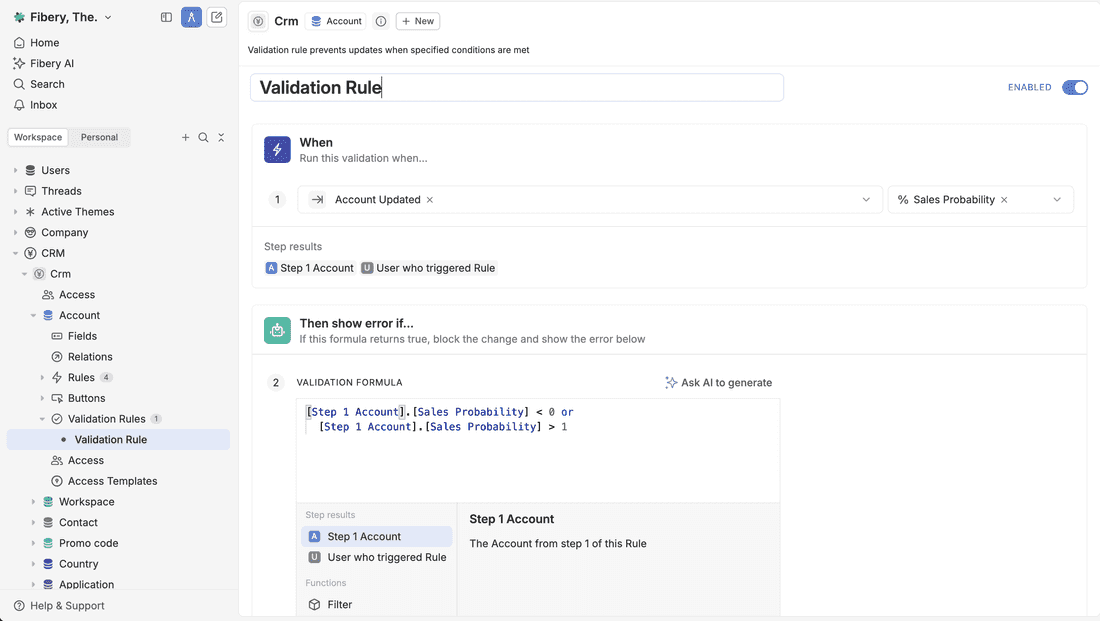
3. Affect as many use cases as possible
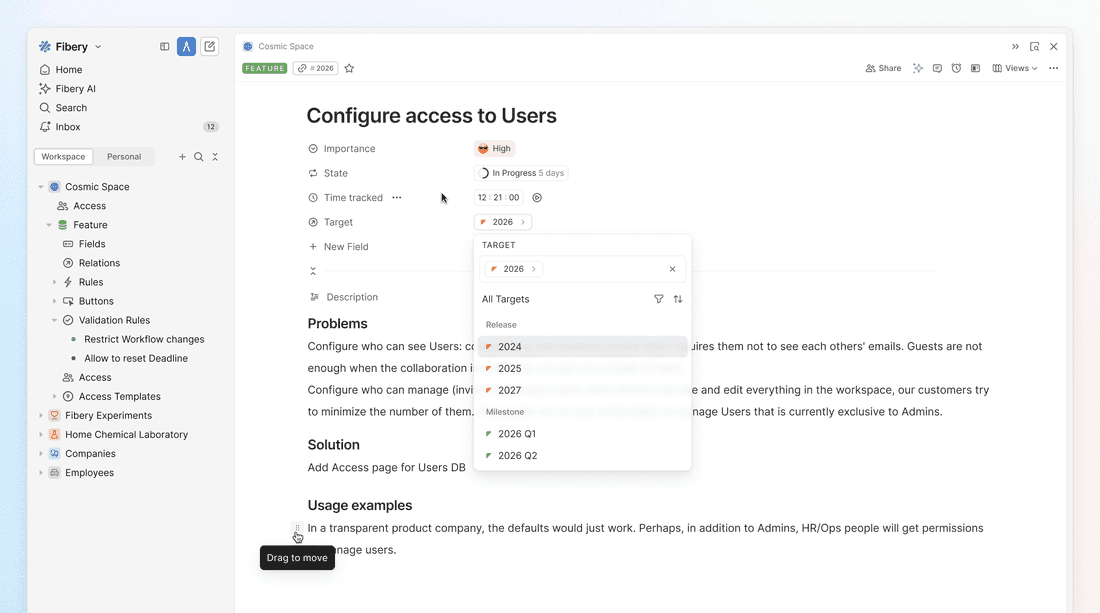
If a feature affects at least three use cases at a quick glance, it’s good to go. Take better Rich Text editing experience, for example. We really want to make the rich-text editor great for the first time, fix a lot of bugs (we have ~100 open bugs in this area), allow reordering text blocks via drag & drop, etc.
Cortisol & Dopamine
We have #dopamine and #cortisol channels in our company Slack. As you can guess, we post positive things into dopamine and negative things into cortisol. It’s not always about the product or company, personal things go there as well. We’ve accumulated several years of activity, it’s time to extract some insights.
Cortisol is declining steadily, while dopamine is tricky. 2025 was our best year, but you couldn’t guess that from dopamine messages… Maybe our company is becoming less emotional? Maybe we’re working more and posting less?
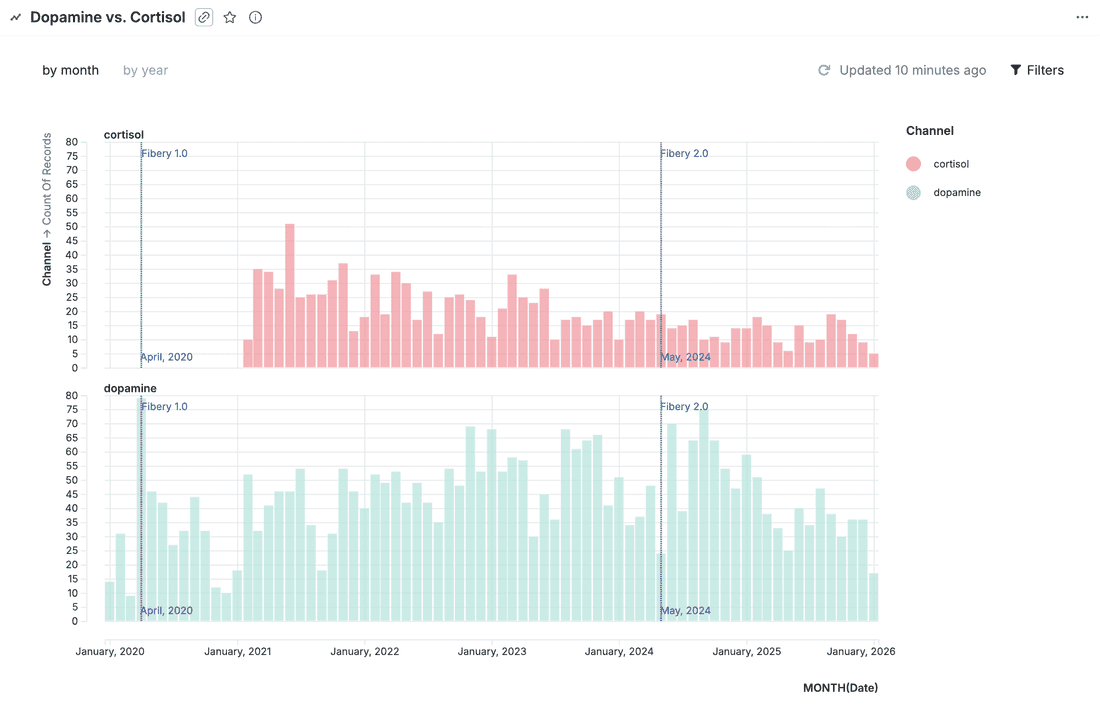
Now we have a new metric — Dopamine/Cortisol ratio.
Year - Dopamine/Cortisol ratio
--
2022 - 2.1
2023 - 2.7
2024 - 3.5
2025 - 3.1
2026 - ?
Cortisol 😨
The worst things from our Slack #cortisol channel in 2025.
Customer YYY answered - they quit fibery because they were acquired by another company that forces to use Jira
So, nothing we can do, these were 4 wonderful years with them— Polina, Head of Customer Success @Fibery
I miss coding…
— Michael, CEO @Fibery

— This deserves a screenshot from our Slack
😰
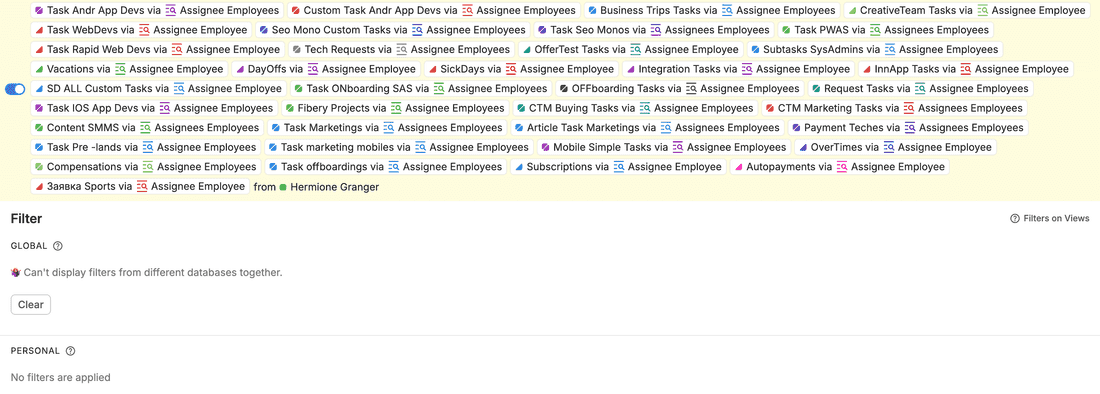
— context filter in a customer’s workspace
Dopamine 😍
The best things from our Slack #dopamine channel in 2025.
We grew in revenue more this spring compared to the entire years 2021, 2022, or 2023
— Anton, happy Head of Growth @Fibery
We no longer have any active paid subscriptions in Braintree because they are all in Chargebee 🐝
— Ilya, the most multi-tasked engineer @Fibery
Got Schengen visa for 2 years 🎉
— Eugene, the fastest engineer @Fibery
I gave it a shot for modelling our donor CRM (currently a hodgepodge of Notion, Asana, and Hubspot) and OH MY GOD IT IS SO GOOD!!! In 2-3 hours I prototyped basically everything I wanted. Unbelievable how flexible it is. It’s not a definite “we’ll switch” yet - I need to discuss with the team - but I think I’m about to become y’alls biggest fan.
— A happy Lead
I’m always blown away how updates make sense. It is well thought every time. Comparing to my time with ClickUp this is next level s*it
— A happy customer
After webinar, Yury from [redacted] called me via Phone to simple share how AMAZING he thinks Fibery is and how he spends most of his working time and how other teammates now ask him to configure smth. Not because they have to but because they want to
— Polina, Head of Customer Success @Fibery
I also have to say that the communication from your end is brilliant, I can really feel the personal approach - keep it up, that’s not a common thing nowadays, I appreciate it!
— From a rejected candidate 🥹
2025 dreams vs. 2025 reality
Overall, this was our best year in terms of how close we came to our dreams! Most dreams came true at around 80%.
Dream: 🙂 Resolve 4 conceptual problems in Fibery (and release Fibery Mobile)
Reality: We did release Fibery Mobile and partially solved 3 conceptual problems. 80% success

Dream: 😀 Keep the team sane
Reality: Most team members are sane. 96% success

Dream: 😁 2x MRR
Reality: 1.85x MRR. 85% success

Dream: 😍 2x number of paid customers (and reach 1000 paid accounts)
Reality: 1.6x, so only 60% success
2026 🍾
Here are our dreams for 2026:
- 😋 Become profitable in Q3 2026
- 😅 Make Fibery more powerful AND easier to use
- 😗 Build an honest and relatable brand that makes us (you included) proud
- 😍 Reach dopamine/cortisol ratio = 4
P.S. This year surprised us in the best way. If you’re a Fibery customer, thank you for staying with us (let me hug you 🤗). If you’re not, 2026 is the best time to give Fibery a try 🏃. We move forward every day. Without hope and without despair. ♥️
Psst... Wanna try Fibery? 👀
Infinitely flexible product discovery & development platform.
More gems from our Radically Honest Blog:


Fibery in 2024. Year in Review
Tl;dr: 280 new paid customers (and 530 total) ❤️. 450 new features and 1400 fixed bugs 💪. 51 new releases 🌶️. Some failures (AI, Product teams strategy) 😱. Some wins (back to roots, your company's operating system focus) 🎢. Dopamine and cortisol 😍😨.

#54 Fibery.io in the First Half of 2024
Eight months have passed since the last Fibery digest, and it's time to reflect on the past and share future plans. From narrowing down core use cases to re-positioning Fibery as a no-code product discovery & development platform

Fibery 2.0 — Product Discovery & Development Platform That Answers Your Questions
If Fibery wasn't your top choice as a PM, it definitely will be from now on. Analyze user feedback & market signals, identify top insights, and unite discovery with development: this is Fibery 2.0