Here at Fibery, we create a modular work platform that serves as an operating system for orgs run by nerds.
This week, we are becoming the 89th product that allows you to create apps with the help of AI — this time on top of Fibery. You type what you want in a chat interface and get a web app. How innovative, we know.
In this article, I’d like to share why we are jumping on this bandwagon think it’s one of the most important releases we’ve had in years.
We can’t build everything
Every product manager knows that saying “no” is 80% of the job. In Fibery, where we feast on generalization, this is especially true.
— Help me visualize the capacity on my sprint planning board.
— No.
In order to provide a quality product, we have to focus on a small set of well-thought and widely reused building blocks.
— Could you please help me replace Powerpoint with Fibery?
— No.
Otherwise, Fibery will turn into ClickUp a mess.
Especially not UIs
What we’ve learned over the years, though, is that while the “backend” blocks are quite universal, the “frontend” parts — not so much.
Databases, formulas, permissions — all these foundational (and boring) things are the same in principle, no matter if you manage a Bible translation non-profit or a cannabis farm. Our Fibery architects build widely different workspaces using the same “backend” blocks.
UI is a different story, though. You can go a long way with Boards, Tables, Timelines, and so on. In fact, we’ve built a moderately successful product on the back of those generic interfaces.
However, there has always been a looong tail of use cases that we couldn’t properly support because they required specialized UIs. We used to suggest workarounds of variable dubiousness or simply waved the white flag.
Not anymore.
So you can build UIs now
We are introducing a way to create custom UIs on top of Fibery. You don’t need to wait for us to build you a new kind of view or a mobile app, you can do it yourself now.
Here are a bunch of examples from our team and beta customers.
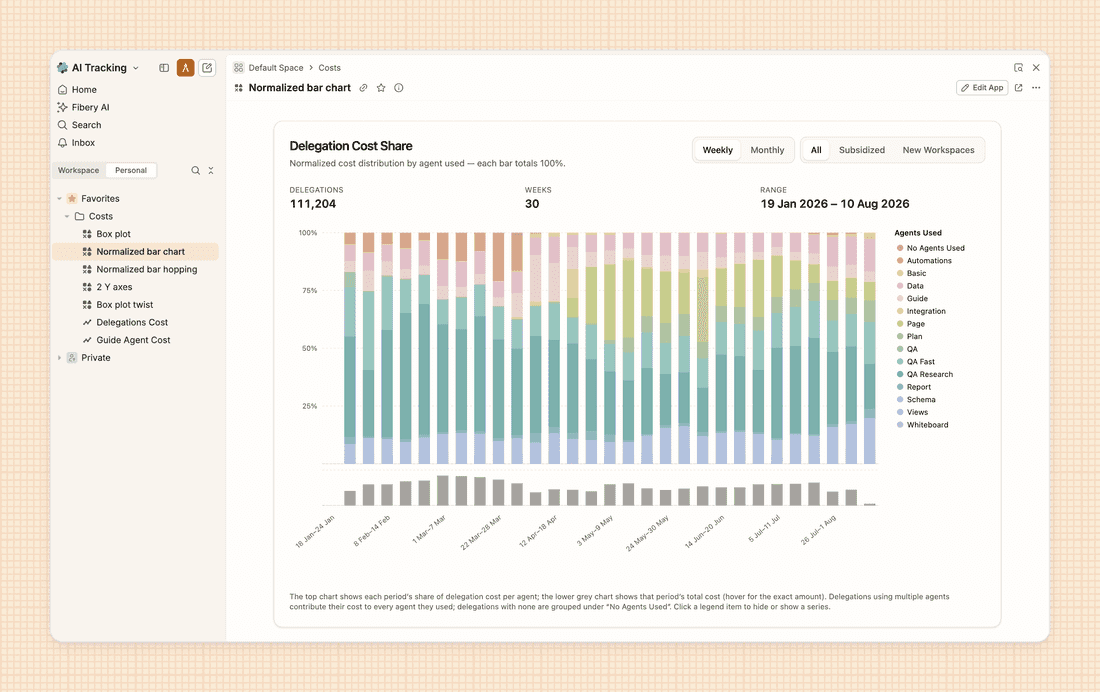
I personally missed a bunch of charts that Fibery Reports don’t offer out of the box, so I built custom apps for box plots, normalized bar charts, and treemaps.
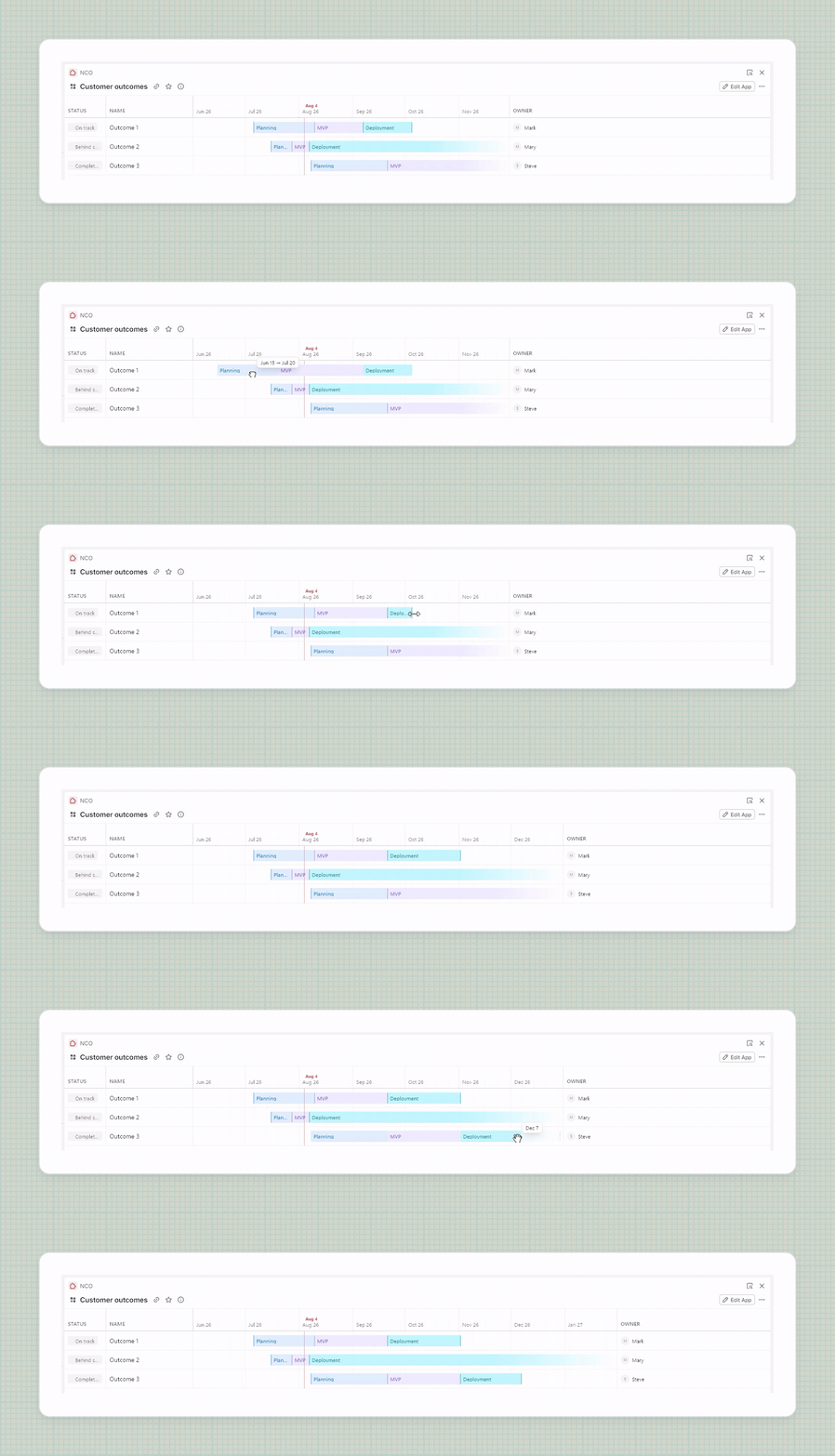
Chris needed to plan stages of projects, not just entire things, so he made a custom interactive timeline.
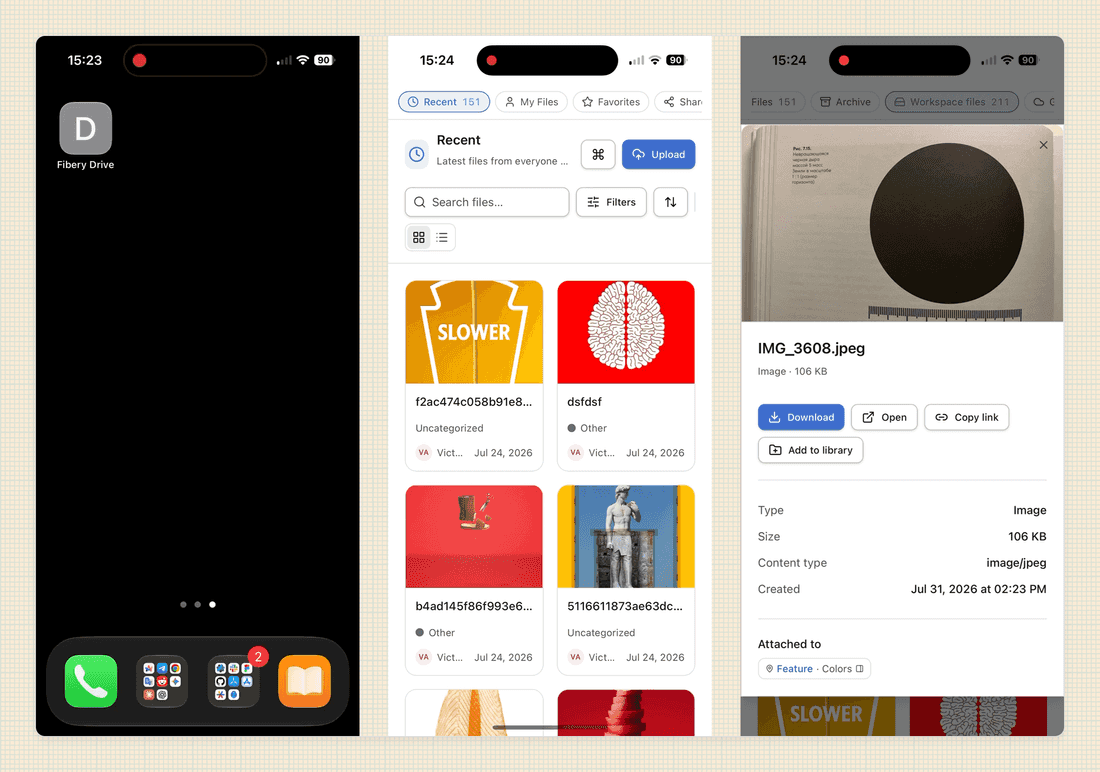
Alex missed an easy way to work with files on the go, so he made a custom mini mobile app.
Custom apps have already seen great adoption among our customers — despite the fact that, up until now, you had to go deep into the settings to enable the experimental feature. Here’s what Jasper who has been tolerating Fibery since 2020 says:
This is very powerful, I love this freedom! We can do things that the Fibery team never foresaw, our creativity is the limit!
Indeed.
Extension points were there
A little backstory.
We envisioned those UI extension points right from the get-go back in 2017. That’s why Fibery Spaces used to be called Apps — they were meant to often include custom interfaces:
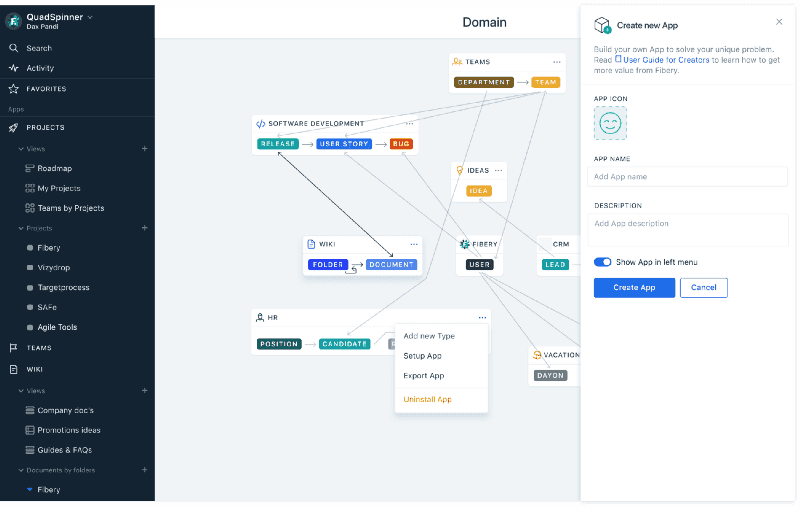
However, it turned out that nobody actually bothered to code their custom UIs. The barrier to entry was too high, so we only used those extension points internally when developing the product.
The arrival of capable LLMs brings those extension ideas back to life.
Now creating interfaces is so ridiculously easy and cheap, you can even justify building throw-away screens you’ll only use once — let alone reusable and collaborative apps for the entire team.
The best thing here is that you don’t have to be a developer — just a patient tinkerer with a clear goal in mind. Exactly the kind of person that usually appreciates Fibery 🫶.
Why build on top of Fibery
Now, why should you use Fibery in the first place? Couldn’t you just vibe-code stuff from scratch or use Loveable?
Michael, our founder, will publish a long and thoughtful answer next week — a thesis on the right set of abstractions and the balance between malleability and time to value. Make sure to follow him. Meanwhile, here’s an AI (Anton Iokov’s) summary in three paragraphs.
Whenever you build on top of Fibery, you don’t have to worry about data integrity, access management, or version history — unforgiving parts that AI still often gets wrong. Those boring bits are on us, while you focus on user experience.
Here, mistakes are easy to spot and fix, and iterations are quick. You might not realize someone would get unwanted access to your vibe-coded app, but you’ll surely notice that Papyrus font.
The data lives in the usual Fibery Databases, so you can resort to the old boring (and reliable) Views at any point. You can also iterate on your app without having to worry about losing data or messing up access.
Go build on top of Fibery
Go build some custom apps! If you haven’t tried Fibery before, this release is a great excuse.
If you have a Claude or a ChatGPT subscription, burn those subsidized tokens to create apps via our MCP. Alternatively, build right in Fibery using the AI credits included in your Fibery plan:
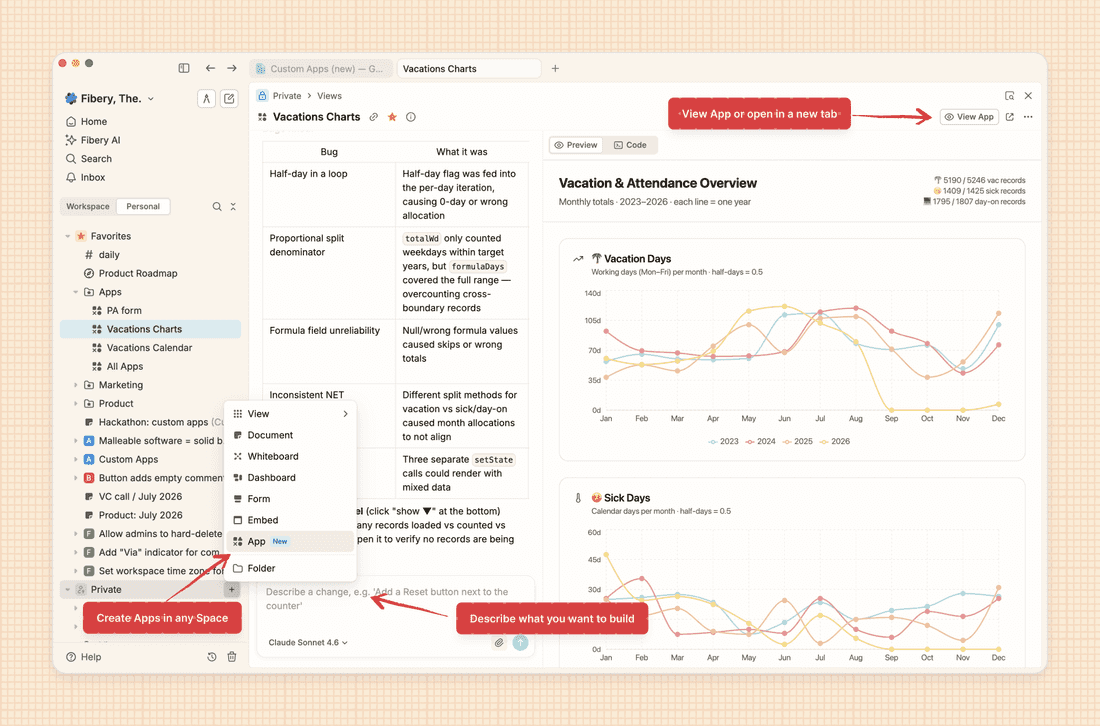
Any productivity or collaboration use case you have in the company, Fibery should be able to handle it now with decent success. If that’s not the case, let us know in the comments below or in the community. And if you build something cool, don’t hesitate to brag on social media. We’d appreciate free marketing!
Meanwhile, we’ll focus on two things now: stronger foundations and better extension points.